
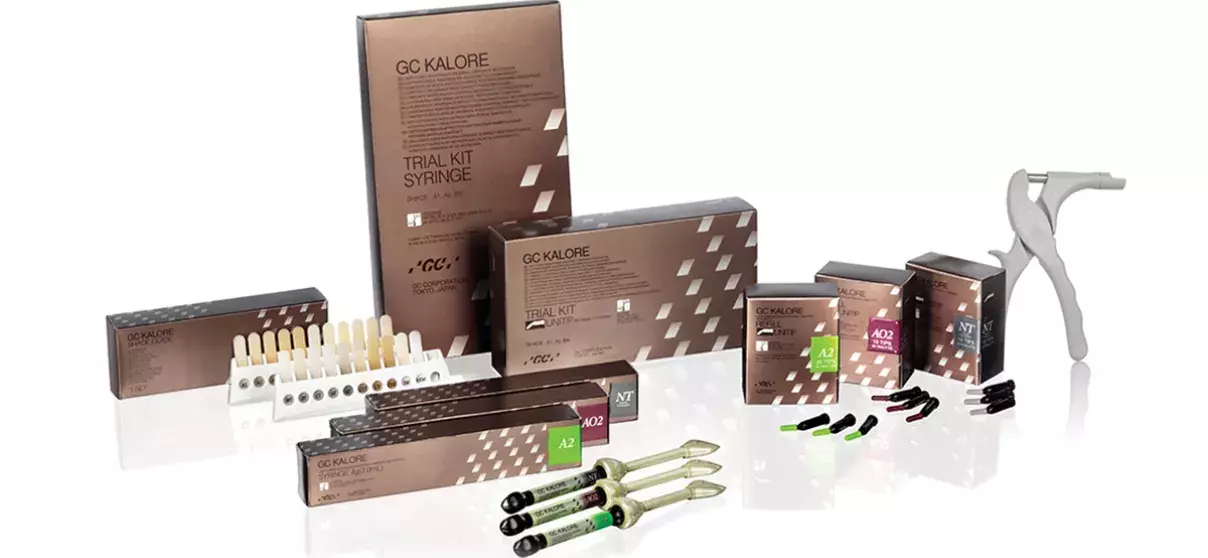
Product Information
KALORE™ challenges the status quo by taking aesthetic restorations to the next level – making them more sculptable, easier to polish with exceptional gloss and highly resistant to wear.
Three components factor into KALORE™'s unique design. First, DuPont's new monomer technology licensed exclusively to KALORE™. Second, GC America’s newly-developed, patented HDR (High Density Radiopaque) prepolymerized fillers. Finally, the proprietary interface between the filler and the matrix is a critical factor in the success and longevity of this composite.
KALORE™ gives you nsurpassed aesthetics; easy polishability, exceptional gloss, and sustained luster.
Why choose KALORE™?
-
Proprietary filler-matrix interface
-
Lowest shrinkage stress of any leading composite*
-
New, patented High Density Radiopaque (HDR) Fillers
-
No filler drop-out
-
Improved durability
-
Less risk of sensitivity
-
Superior handling; non-sticky, non-slumping, and easy to spread
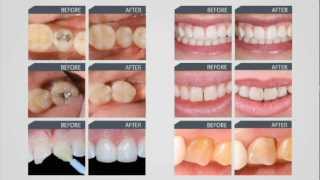
KALORE: New Monomer Technology (Video)

KALORE: Dentrek Module
Related Products
SKU Information
| Trial Kits | |
| Item Number | Description |
| 003624 | Trial Kit Syringe - Contains: Three syringes; A1, A2 and BW; 2.0 mL/4.0 g each. |
| 003569 | Trial Kit Unitip - Contains: Fifty unitips; A1 (20), A2 (20) and BW (10). |
| Syringe Refills | |
| 003577 | Syringe A1 (2.0 mL/4.0 g) |
| 003578 | Syringe A2 (2.0 mL/4.0 g) |
| 003579 | Syringe A3 (2.0 mL/4.0 g) |
| 003580 | Syringe A3.5 (2.0 mL/4.0 g) |
| 003581 | Syringe A4 (2.0 mL/4.0 g) |
| 003572 | Syringe AO2 (2.0 mL/4.0 g) |
| 003573 | Syringe AO3 (2.0 mL/4.0 g) |
| 003574 | Syringe AO4 (2.0 mL/4.0 g) |
| 003582 | Syringe B1 (2.0 mL/4.0 g) |
| 003583 | Syringe B2 (2.0 mL/4.0 g) |
| 003584 | Syringe B3 (2.0 mL/4.0 g) |
| 003590 | Syringe BW (2.0 mL/4.0 g) |
| 003585 | Syringe C2 (2.0 mL/4.0 g) |
| 003586 | Syringe C3 (2.0 mL/4.0 g) |
| 003594 | Syringe CT (2.0 mL/4.0 g) |
| 003588 | Syringe CV (2.0 mL/4.0 g) |
| 003589 | Syringe CVD (2.0 mL/4.0 g) |
| 003597 | Syringe CVT (2.0 mL/4.0 g) |
| 003587 | Syringe D2 (2.0 mL/4.0 g) |
| 003593 | Syringe DT (2.0 mL/4.0 g) |
| 003596 | Syringe GT (2.0 mL/4.0 g) |
| 003595 | Syringe NT (2.0 mL/4.0 g) |
| 003575 | Syringe OBW (2.0 mL/4.0 g) |
| 003576 | Syringe OXBW (2.0 mL/4.0 g) |
| 003592 | Syringe WT (2.0 mL/4.0 g) |
| 003591 | Syringe XBW (2.0 mL/4.0 g) |
| Unitip Refills | |
| 003613 | Unitip A1 (20; 0.16 mL/0.3 g each) |
| 003614 | Unitip A2 (20; 0.16 mL/0.3 g each) |
| 003615 | Unitip A3 (20; 0.16 mL/0.3 g each) |
| 003616 | Unitip A3.5 (20; 0.16 mL/0.3 g each) |
| 003617 | Unitip A4 (20; 0.16 mL/0.3 g each) |
| 003598 | Unitip AO2 (10; 0.16 mL/0.3 g each) |
| 003599 | Unitip AO3 (10; 0.16 mL/0.3 g each) |
| 003600 | Unitip AO4 (10; 0.16 mL/0.3 g each) |
| 003618 | Unitip B1 (20; 0.16 mL/0.3 g each) |
| 003619 | Unitip B2 (20; 0.16 mL/0.3 g each) |
| 003620 | Unitip B3 (20; 0.16 mL/0.3 g each) |
| 003605 | Unitip BW (10; 0.16 mL/0.3 g each) |
| 003621 | Unitip C2 (20; 0.16 mL/0.3 g each) |
| 003622 | Unitip C3 (20; 0.16 mL/0.3 g each) |
| 003609 | Unitip CT (10; 0.16 mL/0.3 g each) |
| 003603 | Unitip CV (10; 0.16 mL/0.3 g each) |
| 003604 | Unitip CVD (10; 0.16 mL/0.3 g each) |
| 003612 | Unitip CVT (10; 0.16 mL/0.3 g each) |
| 003623 | Unitip D2 (20; 0.16 mL/0.3 g each) |
| 003608 | Unitip DT (10; 0.16 mL/0.3 g each) |
| 003611 | Unitip GT (10; 0.16 mL/0.3 g each) |
| 003610 | Unitip NT (10; 0.16 mL/0.3 g each) |
| 003601 | Unitip OBW (10; 0.16 mL/0.3 g each) |
| 003602 | Unitip OXBW (10; 0.16 mL/0.3 g each) |
| 003607 | Unitip WT (10; 0.16 mL/0.3 g each) |
| 003606 | Unitip XBW (10; 0.16 mL/0.3 g each) |
| Accessories | |
| 003571 | Shade Guide |