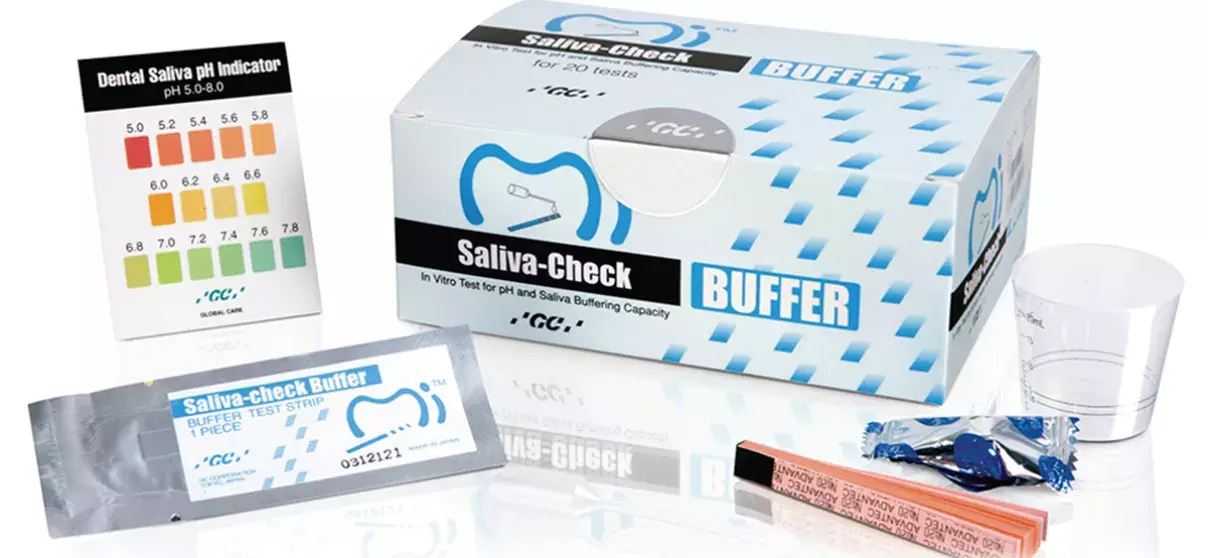
Saliva-Check BUFFER Kit Test for Saliva Quality, pH and Buffering Capacity
Features and Benefits
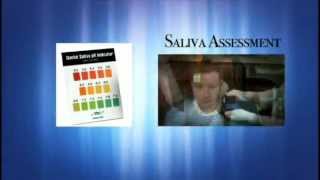
Comprehensive Saliva Testing
Hydration testing measures salivary production.
Salivary Consistency testing visually assesses the viscosity of unstimulated saliva.
Resting Saliva pH testing measures the pH of unstimulated saliva.
Stimulated Saliva Flow testing measures the quantity of saliva produced in 5 minutes while chewing an unflavored piece of wax.
Stimulated Saliva pH testing measures the pH of saliva produced under masticatory stimulus.
Saliva Buffering Capacity testing measures the ability of saliva to minimize an acid challenge.
Simple Test Procedures
Hydration testing measures salivary production.
Salivary Consistency testing visually assesses the viscosity of unstimulated saliva.
Resting Saliva pH testing measures the pH of unstimulated saliva.
Stimulated Saliva Flow testing measures the quantity of saliva produced in 5 minutes while chewing an unflavored piece of wax.
Stimulated Saliva pH testing measures the pH of saliva produced under masticatory stimulus.
Saliva Buffering Capacity testing measures the ability of saliva to minimize an acid challenge.
All 6 tests take less than 10 minutes total per patient.
In most cases, tests can be performed by trained auxiliaries.
Saliva-Check makes it easier to initiate change in patient hygiene.
Patient Test Packaging
Prevents possibility of cross contamination to assure accurate results.
Easily works into the patients oral examination procedure.
Educational Tool for Patients
Helps patient strive for oral balance.
Identifies saliva problems and assists in preventive treatment planning.
Helps patient strive for oral balance and improve oral health by achieving an equilibrium between the demineralizing effect of bacteria and acids on tooth surfaces and the buffering and remineralizing benefits of saliva.
Demonstrates Salivary Dysfunction to Patient
Offers factual explanation for disfunctions such as difficulty in eating or swallowing, changes in taste, tooth sensitivity, soft tissue trauma and inadequate denture retention.
Validate signs of patient salivary disfunction including frothy mucinous saliva, increased saliva viscosity, sublingual pooling, dry mucas strands, tongue coating, epithelial atrophy, poorly mineralized calculus or no calculus on lower anterior teeth, poor labial minor salivary gland production, candidal infection, cervical plaque, coronol and root surface caries, accelerated tooth wear and erosion, as well as cervical dentinal hypersensitivity.
Helps Find Factors Affecting Salivary Disfunction
Communication vehicle to identify contributing factors like dehydration, stress, smoking, disease, salivary gland pathology, chronic renal failure, drug abuse, menopausal hormone imbalance and medicine side effects.
Assists in Diagnosis and Preventive Treatment Design
Offer improved preventive treatment to your patients.
Correct problems before damage occurs.
Improves patient communication and motivation.
Start a new profit center for the dental practice.